By clicking “Accept”, you agree to the storing of cookies on your device to enhance site navigation, analyze site usage, and assist in our marketing efforts. View our Privacy Policy for more information.
Milestone Achievement – Forbes India Select 200 DGEMS Recognizes WebDataGuru for Data Intelligence & AI-Driven Price Insights 🎉
Milestone Achievement – Forbes India Select 200 DGEMS Recognizes WebDataGuru for Data Intelligence & AI-Driven Price Insights 🎉
Milestone Achievement – Forbes India Select 200 DGEMS Recognizes WebDataGuru for Data Intelligence & AI-Driven Price Insights 🎉
Milestone Achievement – Forbes India Select 200 DGEMS Recognizes WebDataGuru for Data Intelligence & AI-Driven Price Insights 🎉
Milestone Achievement – Forbes India Select 200 DGEMS Recognizes WebDataGuru for Data Intelligence & AI-Driven Price Insights 🎉
Milestone Achievement – Forbes India Select 200 DGEMS Recognizes WebDataGuru for Data Intelligence & AI-Driven Price Insights 🎉
Milestone Achievement – Forbes India Select 200 DGEMS Recognizes WebDataGuru for Data Intelligence & AI-Driven Price Insights 🎉
Milestone Achievement – Forbes India Select 200 DGEMS Recognizes WebDataGuru for Data Intelligence & AI-Driven Price Insights 🎉
Milestone Achievement – Forbes India Select 200 DGEMS Recognizes WebDataGuru for Data Intelligence & AI-Driven Price Insights 🎉
Milestone Achievement – Forbes India Select 200 DGEMS Recognizes WebDataGuru for Data Intelligence & AI-Driven Price Insights 🎉
Milestone Achievement – Forbes India Select 200 DGEMS Recognizes WebDataGuru for Data Intelligence & AI-Driven Price Insights 🎉
Milestone Achievement – Forbes India Select 200 DGEMS Recognizes WebDataGuru for Data Intelligence & AI-Driven Price Insights 🎉
Milestone Achievement – Forbes India Select 200 DGEMS Recognizes WebDataGuru for Data Intelligence & AI-Driven Price Insights 🎉
Milestone Achievement – Forbes India Select 200 DGEMS Recognizes WebDataGuru for Data Intelligence & AI-Driven Price Insights 🎉
Milestone Achievement – Forbes India Select 200 DGEMS Recognizes WebDataGuru for Data Intelligence & AI-Driven Price Insights 🎉
Milestone Achievement – Forbes India Select 200 DGEMS Recognizes WebDataGuru for Data Intelligence & AI-Driven Price Insights 🎉
Milestone Achievement – Forbes India Select 200 DGEMS Recognizes WebDataGuru for Data Intelligence & AI-Driven Price Insights 🎉
Milestone Achievement – Forbes India Select 200 DGEMS Recognizes WebDataGuru for Data Intelligence & AI-Driven Price Insights 🎉
Milestone Achievement – Forbes India Select 200 DGEMS Recognizes WebDataGuru for Data Intelligence & AI-Driven Price Insights 🎉
Milestone Achievement – Forbes India Select 200 DGEMS Recognizes WebDataGuru for Data Intelligence & AI-Driven Price Insights 🎉
Milestone Achievement – Forbes India Select 200 DGEMS Recognizes WebDataGuru for Data Intelligence & AI-Driven Price Insights 🎉
Milestone Achievement – Forbes India Select 200 DGEMS Recognizes WebDataGuru for Data Intelligence & AI-Driven Price Insights 🎉
Milestone Achievement – Forbes India Select 200 DGEMS Recognizes WebDataGuru for Data Intelligence & AI-Driven Price Insights 🎉
Milestone Achievement – Forbes India Select 200 DGEMS Recognizes WebDataGuru for Data Intelligence & AI-Driven Price Insights 🎉
Milestone Achievement – Forbes India Select 200 DGEMS Recognizes WebDataGuru for Data Intelligence & AI-Driven Price Insights 🎉
Milestone Achievement – Forbes India Select 200 DGEMS Recognizes WebDataGuru for Data Intelligence & AI-Driven Price Insights 🎉
Milestone Achievement – Forbes India Select 200 DGEMS Recognizes WebDataGuru for Data Intelligence & AI-Driven Price Insights 🎉
Milestone Achievement – Forbes India Select 200 DGEMS Recognizes WebDataGuru for Data Intelligence & AI-Driven Price Insights 🎉
Milestone Achievement – Forbes India Select 200 DGEMS Recognizes WebDataGuru for Data Intelligence & AI-Driven Price Insights 🎉
Milestone Achievement – Forbes India Select 200 DGEMS Recognizes WebDataGuru for Data Intelligence & AI-Driven Price Insights 🎉
Milestone Achievement – Forbes India Select 200 DGEMS Recognizes WebDataGuru for Data Intelligence & AI-Driven Price Insights 🎉
Milestone Achievement – Forbes India Select 200 DGEMS Recognizes WebDataGuru for Data Intelligence & AI-Driven Price Insights 🎉
Milestone Achievement – Forbes India Select 200 DGEMS Recognizes WebDataGuru for Data Intelligence & AI-Driven Price Insights 🎉
Milestone Achievement – Forbes India Select 200 DGEMS Recognizes WebDataGuru for Data Intelligence & AI-Driven Price Insights 🎉
Milestone Achievement – Forbes India Select 200 DGEMS Recognizes WebDataGuru for Data Intelligence & AI-Driven Price Insights 🎉
Milestone Achievement – Forbes India Select 200 DGEMS Recognizes WebDataGuru for Data Intelligence & AI-Driven Price Insights 🎉
Milestone Achievement – Forbes India Select 200 DGEMS Recognizes WebDataGuru for Data Intelligence & AI-Driven Price Insights 🎉
Milestone Achievement – Forbes India Select 200 DGEMS Recognizes WebDataGuru for Data Intelligence & AI-Driven Price Insights 🎉
Milestone Achievement – Forbes India Select 200 DGEMS Recognizes WebDataGuru for Data Intelligence & AI-Driven Price Insights 🎉
Milestone Achievement – Forbes India Select 200 DGEMS Recognizes WebDataGuru for Data Intelligence & AI-Driven Price Insights 🎉
Milestone Achievement – Forbes India Select 200 DGEMS Recognizes WebDataGuru for Data Intelligence & AI-Driven Price Insights 🎉
Milestone Achievement – Forbes India Select 200 DGEMS Recognizes WebDataGuru for Data Intelligence & AI-Driven Price Insights 🎉
Milestone Achievement – Forbes India Select 200 DGEMS Recognizes WebDataGuru for Data Intelligence & AI-Driven Price Insights 🎉
Milestone Achievement – Forbes India Select 200 DGEMS Recognizes WebDataGuru for Data Intelligence & AI-Driven Price Insights 🎉
Milestone Achievement – Forbes India Select 200 DGEMS Recognizes WebDataGuru for Data Intelligence & AI-Driven Price Insights 🎉
Milestone Achievement – Forbes India Select 200 DGEMS Recognizes WebDataGuru for Data Intelligence & AI-Driven Price Insights 🎉
Milestone Achievement – Forbes India Select 200 DGEMS Recognizes WebDataGuru for Data Intelligence & AI-Driven Price Insights 🎉
Milestone Achievement – Forbes India Select 200 DGEMS Recognizes WebDataGuru for Data Intelligence & AI-Driven Price Insights 🎉
Milestone Achievement – Forbes India Select 200 DGEMS Recognizes WebDataGuru for Data Intelligence & AI-Driven Price Insights 🎉
Milestone Achievement – Forbes India Select 200 DGEMS Recognizes WebDataGuru for Data Intelligence & AI-Driven Price Insights 🎉
Milestone Achievement – Forbes India Select 200 DGEMS Recognizes WebDataGuru for Data Intelligence & AI-Driven Price Insights 🎉
Milestone Achievement – Forbes India Select 200 DGEMS Recognizes WebDataGuru for Data Intelligence & AI-Driven Price Insights 🎉
Milestone Achievement – Forbes India Select 200 DGEMS Recognizes WebDataGuru for Data Intelligence & AI-Driven Price Insights 🎉
Milestone Achievement – Forbes India Select 200 DGEMS Recognizes WebDataGuru for Data Intelligence & AI-Driven Price Insights 🎉
Milestone Achievement – Forbes India Select 200 DGEMS Recognizes WebDataGuru for Data Intelligence & AI-Driven Price Insights 🎉
Milestone Achievement – Forbes India Select 200 DGEMS Recognizes WebDataGuru for Data Intelligence & AI-Driven Price Insights 🎉
Milestone Achievement – Forbes India Select 200 DGEMS Recognizes WebDataGuru for Data Intelligence & AI-Driven Price Insights 🎉
Milestone Achievement – Forbes India Select 200 DGEMS Recognizes WebDataGuru for Data Intelligence & AI-Driven Price Insights 🎉
Milestone Achievement – Forbes India Select 200 DGEMS Recognizes WebDataGuru for Data Intelligence & AI-Driven Price Insights 🎉
Milestone Achievement – Forbes India Select 200 DGEMS Recognizes WebDataGuru for Data Intelligence & AI-Driven Price Insights 🎉
Milestone Achievement – Forbes India Select 200 DGEMS Recognizes WebDataGuru for Data Intelligence & AI-Driven Price Insights 🎉
Milestone Achievement – Forbes India Select 200 DGEMS Recognizes WebDataGuru for Data Intelligence & AI-Driven Price Insights 🎉
Milestone Achievement – Forbes India Select 200 DGEMS Recognizes WebDataGuru for Data Intelligence & AI-Driven Price Insights 🎉
Milestone Achievement – Forbes India Select 200 DGEMS Recognizes WebDataGuru for Data Intelligence & AI-Driven Price Insights 🎉
Milestone Achievement – Forbes India Select 200 DGEMS Recognizes WebDataGuru for Data Intelligence & AI-Driven Price Insights 🎉
Milestone Achievement – Forbes India Select 200 DGEMS Recognizes WebDataGuru for Data Intelligence & AI-Driven Price Insights 🎉
AI Web Scraping: The Future of Scalable Data Collection
Trevor Benson
|
4.11.2025
Two years was all it took for data created worldwide to reach 90% of the total being. However, many companies are still unable to scrape even a small portion of the needed web data for them to remain competitive. Data availability is not the problem here, rather it is the old-fashioned ways of extracting that data still used by businesses that cause trouble.
AI web scraping is an advanced tool for the data collection process that can carry out machine learning, and provide newspapers and visualizers with structured information from sites only, adapting to the specific website changes and doing it all without a human being involved.
The conventional web scraping ways are gradually fading out because of the overwhelming difficulties of the present-day web. Everyday there are new layout changes for the sites, anti-bot protections are increasing and very costly maintenance of the manual tools means much to the prices that remain very tight.
For businesses in retail, e-commerce, production and industrial supply chains these are great losses in terms of no-timely-awareness about the competitors' prices, lack of correct data for the management to take decisions and being behind the market trends.
This guide unveils the AI web scraping facilitation and businesses to turn these challenges into opportunities while cutting costs and making large-scaled data collection possible. You will learn about the techs that make this change happen, the industries that already benefit from real-life applications and the ways to introduce AI scraping in your business.
AI-Powered Web Scraping: What Is It and How Does It Work?
AI web scraping is a very different approach that has moved from the previously used rigid- rule based extraction to AI directed adaptive data collection. Earlier a traditional scraper would stop functioning whenever a website changed its CSS class. In contrast, AI based systems would be able to understand web content just as a human would do and contextually.
Here is the key difference: traditional web scraping fixed its attention on HTML selectors or tags that were not only difficult to monitor manually but also costly to maintain because with every site structure change, they had to be updated manually.
Traditional Scraping vs. AI Web Scraping: A Clear Comparison
Aspect
Traditional Scraping
AI Web Scraping
Maintenance
Manual updates for each site change
Self-healing with automatic adaptation
Scalability
Linear cost increase per site
Horizontal scaling with minimal overhead
Setup Time
Days to weeks per site
Hours with trained models
Accuracy
Breaks frequently (60-70% uptime)
95%+ success rate with fallbacks
Cost Structure
High ongoing maintenance
Higher initial, lower long-term costs
The Core Technologies Powering AI Web Scraping
AI scraping isn't a single technology—it's an orchestrated system of advanced capabilities working together:
The AI systems rely on machine learning models to be the visual input of the entire operation. The Computer vision algorithms will be able to determine the objects by their visual characteristics—so the pricing will be identified through the location, font size, and the distance to the product images, not merely an HTML tag.
Natural Language Processing (NLP) deals with the extraction of meaning from unstructured text. In the case of web scraping of product descriptions or customer reviews, NLP models are able to spot the entities such as brand names, model numbers, specs, and emotions without the need of any specific patterns being preset.
Deep Learning Networks can spot the similarities in thousands of various site structures. After getting trained on the e-commerce websites, these networks can pin down the product data with great accuracy from the retailers even if they have never been exposed to them before.
Algorithms that adapt keep on learning and improving. The system will determine the reason for the failure each time the extraction process is unsuccessful and will alter its strategy accordingly. Moreover, it will use the knowledge acquired for the future scraping tasks. In this way, web scraping tools that can literally self-improve are becoming a reality.
Whether you are looking for pricing intelligence, market research studies, or private data scraping on a large scale, WebDataGuru does provide AI-driven solutions that truly fit into your realm. Contact us now →
Why Are Companies Switching to AI for Data Extraction?
The business case for AI-powered data scraping goes beyond just technical superiority. It fundamentally changes the economics and strategic value of web data collection.
1. Unparalleled Scalability That Transforms Data Strategy
AI web scraping is not only capable of scaling to a great extent but also to a smart extent. It will be just as easy to extract pricing data from 10,000 competitor websites as it is from 10. The innovation is not in the sheer amount of data processed but in keeping the accuracy and the reliability at large volume without the corresponding increase in resources.
A well-known automotive parts manufacturer could follow online prices of 50 competitor websites with the help of a team of 3 developers using traditional methods. After AI scraping was put into practice, they were able to track 2,500 suppliers and competitors with the same team, and the price updates were done hourly instead of weekly.
2. Adaptive Intelligence That Reduces Maintenance Costs Drastically
Website alterations are the hidden reason for the downfall of traditional scraping ventures. Websites keep changing their layouts, redoing their coding, and employing new anti-bot techniques. And each change implies that the system needs to be manually intervened with, tested, and redeployed.
With the help of AI, web scraping systems can not only detect but also adapt to the changes automatically. For instance, if a retailer changes the structure of their product pages, the AI model will recognize the new pattern and will be able to modify the extraction logic in real-time. Following the transition to AI scraping, organizations are claiming maintenance overheads have been cut by 80-90%.
Self-healing scrapers are not a concept of the future but rather a part of the present in production. The extraction quality is being monitored by the system, anomalies are being identified, and alternative strategies are being automatically applied before the human operators are able to notice an issue.
3. Enhanced Data Quality Through Contextual Understanding
Traditional data scraping tools extract what you tell them to extract. AI scraping understands what you're trying to extract and makes intelligent decisions about data quality.
Context-aware extraction means the system recognizes when a "$19.99" refers to a price versus a product dimension or SKU. It validates that extracted phone numbers follow proper formatting, dates make logical sense, and product categories align with the actual content.
Automatic validation is a process that eliminates errors from the very beginning. AI scrapers provide the data that is structured and validated and ready for immediate use in pricing intelligence, market research, and analytics workflows instead of the hours of analyst time consuming downstream data cleansing.
4. Cost Efficiency That Improves Over Time
The total cost calculation for AI web scraping looks different from traditional approaches. Initial implementation requires higher investment—training models, building infrastructure, and integrating systems. However, the ROI curve inverts rapidly.
Within a period of 3-6 months, most organizations achieve cost parity with traditional methods. By the end of the year, total costs are usually 40-60% less than those of legacy methods and at the same time 5-10x more data volume is delivered.
Resource reallocation becomes possible. Instead of developers maintaining brittle scrapers, they build strategic data products. Your team shifts from firefighting broken scripts to generating business value from the intelligence collected.
Ready to see these benefits in your data pipeline? WebDataGuru's custom data extraction solutions are built on advanced AI architectures designed specifically for large-scale collection.
What Can You Do With AI Web Scraping? Real-World Applications
Theoretical discussions can be engaging, but it is the results that truly count. Here is how the innovative companies in different sectors are using the AI-powered website scraping technology to gain a competitive edge.
1. E-commerce and Competitive Intelligence
Retailers and brands are employing AI scraping to keep an eye on their competitors’ pricing, stock, and promotions in real-time. A nationwide sports goods retailer keeps track of 500 competitors through 50,000 SKUs and sets the price up or down in response to competition and demand signals.
The optimization of prices will be done on an hourly basis instead of a weekly one. Inventory checks notify the merchandising departments when the competitors run out of stock, thus creating chances for sales. Market share analysis uncovers category trends even before they are reported in the industry reports.
The return on investment is clear; the retailers adopting AI-powered pricing intelligence report margin increases of 2-4% and a rise of 8-12% in converting customers who were previously lost to competitors.
2. Financial Services and Alternative Data Intelligence
Hedge funds and investment firms are increasingly turning to the web-scraped alternative data. AI-based mechanisms uncover signals that are beyond traditional analyses—social media sentiment, job posting trends, product review volumes, and real-estate listing patterns.
Market sentiment analysis takes into account millions of social media posts, news articles, and online discussions and thus can express the public view on stocks, sectors, or economic trends. News aggregation provides real-time information milliseconds after its release, which makes algorithmic trading strategies possible.
Regulatory monitoring automatically observes SEC filings, patent applications, and various government digital repositories, providing analysts with alerts of significant changes that require action.
AI-powered web scraping for alternative data is being used by some trading firms that report a 15-30% increase in the accuracy of their predictions as compared to relying solely on traditional financial data sources.
3. Real Estate and Property Intelligence
If an investor in real estate, a property aggregator, or an analytics platform is looking for property data, he should be looking for the best and most up-to-date information. AI scraping organizes hundreds of regional MLS database listings, listings from for-sale-by-owner sites, and international property platforms.
Listing aggregation produces a single database, even though the various sources have very different formats. Market trend analysis detects price changes, shifts in inventory, and the rise of new investment opportunities before they become commonly known.
The investment opportunity identification process gives each property a score based on the investor's own criteria, which may include cash flow potential, appreciation probability, or development viability.
Real estate investment firms using AI-scraped market intelligence claim they are 40% faster at identifying deals and achieving 25% better returns on investments.
4. Lead Generation and B2B Intelligence
Through AI web scraping, sales and marketing teams gain access to a new world of contact and company intel. Not only that but also all over the internet, uncover decision-making personnel, the technology used by the company, the funding situation, and the signs of growth.
On the one hand, contact discovery locates a huge number of email addresses, phone numbers, and LinkedIn profiles. On the other hand, company enrichment automatically takes care of collecting firmographics data, identifying technology stacks, and drawing organizational charts.
Market research automation works by detecting target accounts that are the best fit for the ideal customer profile, support outreach in terms of timing, and personalize messaging based on the already gathered intelligence.
B2B companies that are using AI-driven lead generation say that they have experienced a 3-5x increase in the number of qualified leads and a 30-40% decrease in the cost of acquiring a lead.
5. Brand and Reputation Monitoring
Consumer brands demand to have a complete picture of their online mentions, reviews, and competition. AI scraping, on the other hand, does the job of aggregating this dispersed data into a coherent and actionable form.
The process of review aggregation involves the collection of customer opinions and comments from different places such as retailer sites, review platforms, and social media. Sentiment analysis plays the role of automatically sorting feedback into positive, negative, or neutral categories and at the same time pinpointing the main themes.
The competitive positioning exposes the good as well as the bad sides of a brand compared with its competitors in terms of reviews, ratings, and share of voice across various channels.
The brands that have adopted AI-powered reputation monitoring can spot crises 70% faster and take measures to limit the effects of negative trends on sales by a timely response.
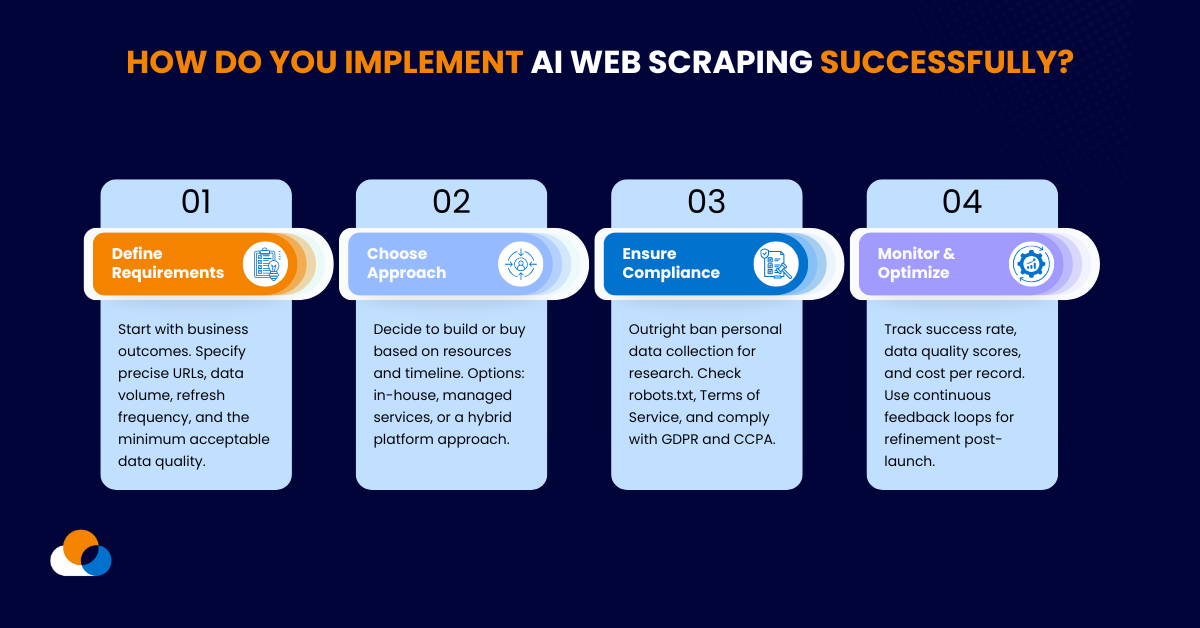
How Do You Implement AI Web Scrapings?
Transitioning from just an idea to a working product requires a proper plan and execution. If you stick with this structure, reliable implementation is guaranteed.
Step 1: Specify Data Requirements Precisely
Do not start with technical requirements; instead, start with business outcomes. What decisions will this data support? What actions will it make possible?
Applications of the targeted websites should be very clear—precise URLs, data refresh frequency, and volume requirements.
Required data fields should be specified with examples of the lowest quality levels that are acceptable.
Timeliness of updates should be determined by balancing the needs and costs involved.
Having clear requirements helps to avoid scope creep and guarantees that the system will deliver real business value.
Step 2: Select Your Implementation Pathway
The choice of building or purchasing is conditioned by the company's tech capabilities, schedule, and strategic plan for the future.
If you have a team of ML engineers capable of extreme customization, require full control, and want to have developed the product in-house, expect 6 to 12 months for the production and continuous maintenance overhead.
When the need is for proven reliability, quicker time to value, and the wish of the company to focus its internal resources on core business applications rather than data collection infrastructure, then using web scraping services like WebDataGuru would be appropriate.
Another option is to consider hybrid approaches whereby managed platforms are used for baseline collection and then custom extensions are built for unique requirements.
Step 3: Legal and Ethical Compliance Confirmation
Web scraping legally acts in a too complicated way. To protect your organization, it is completely necessary to follow the best practices:
Outright ban on personal data collection. This is solely for research or data analysis. Take the above-mentioned precautions and more practices from the list below, such as: Disallowed robots.txt files that specify the scraping preferences.
It is always a good idea to check the Terms of Service for possible prohibitions, even though it is important to note that these terms are not always legally binding. Make yourself familiar with GDPR, CCPA, and other privacy regulations that apply to certain sectors.
Limit the scraping attempt per minute so that the target websites are not shaken. Avoid scraping of personal data under any circumstance unless there is a legitimate business purpose and a legal basis.
Adhering to legal regulations is more than just a risk management measure; it is an excellent corporate practice and a long-term strategy.
Step 4: Monitor Performance and Optimize Continuously
The launch process is not just a once and for all affair. It is the starting point of the optimization. Keep an eye on important metrics:
The degree of success related to the particular site, data field, and period of time in which to spot the patterns. Data quality scores that score on accuracy, completeness, and timeliness. Cost per record for keeping the ROI positive.
Set up quality assurance methods employing sample validation and anomaly detection. Make feedback loops so that the business users can report system issues and thus help to improve the system's accuracy over time.
The best web scraping tools improve continuously through this monitoring and refinement cycle.
What Challenges Should You Expect With AI Web Scraping?
During AI web scraping process transparency is the one that builds trust. It is a fact that the AI web scraping technology can solve multiple problems at once but still there are some challenges to deal with. Communication of such impediments at the very beginning empowers one to plan better and set realistic expectations.
The complexity of the initial setup can turn out to be quite significant. It takes great knowledge and skills to make the machine learning models with the help of labelled data. Therefore, it is advisable to budget generously for the time and resource implementation.
Overseeing the validation of data quality is still a task for a human. The systems used for AI do get accuracy that is very close to 100% but they are not infallible. Therefore, it is necessary to implement the process of sampling and review for catching the edge cases.
The measures taken by websites to stop scraping are still evolving. The situation is similar to an arms race where new detection methods are being implemented by sites and scrapers are developing countermeasures. It is smart to go for the solutions that have active development and threat intelligence.
Compliance with regulations depends on the jurisdiction and use case. The legal status of data scraping varies greatly between regions and some areas are still undecided regarding this matter. It is advisable to consult a lawyer if the application is of high value.
The entry barrier for the organizational-level systems is very high and the cost can be substantial. Nevertheless, one should not forget to compare the costs with the entire cost of ownership for the alternatives, including the maintenance overhead.
What Does the Future Hold for AI Web Scraping?
Generative AI integration indeed will lead to even more complex extraction capabilities. The large language models are capable of not only understanding context and intent, but also that of current users' systems, thus, being able to disclose complex information that the former candidates.
The no-code platforms are giving access to the growing number of people. Business users will be able to soon build intricate scraping workflows by way of natural language without the need for any professional programming.
The natural language queries will take over the complex configurations. Rather than setting up the rules for extraction all you need to do is to put your request in simple words: "Give me every product review that talks about durability from the top 20 outdoor gear retailers".
The prediction of scraping will be data need driven. The systems will observe your pattern of use and gather the information beforehand so that you will not even be aware that you need it. The blockchain data provenance might become customary for the high-value data and in this way, the auditable trails that verify when and how data was collected would be created.
The organizations that apply the AI web scraping today will be the first ones to quickly get the benefits of these advances and thus,; they will also be the ones that keep the competitive edge throughout the evolution of the technology.
Frequently Asked Questions
1. Is AI web scraping legal?
Web scraping done with AI is legal if it is carried out responsibly, especially when the data being scraped is publicly available. When in doubt, consult a legal expert for region-specific guidance. Always respect robots.txt files and a website’s Terms of Service.
2. What is the price of AI web scraping?
The price for AI web scraping services varies based on project size, data complexity, update frequency, and automation level. Some companies build in-house solutions for greater control, while others use managed data extraction services for faster results and scalability.
3. What are the differences between AI scraping and conventional scraping?
Traditional scraping relies on fixed HTML selectors that break when websites change. AI scraping, powered by machine learning, interprets web content contextually and adapts automatically. It efficiently handles complex, JavaScript-heavy websites, making it ideal for large-scale or frequently changing data needs.
4. What is AI web scraping accuracy rate?
AI-driven scrapers achieve 95–99% accuracy for structured data extraction, compared to 60–70% with manual or rule-based scraping. Fields such as prices and SKUs often reach 98% accuracy or more with AI-powered solutions.
5. Which sectors reap the most benefits from AI web scraping?
E-commerce and retail use AI web scraping for price tracking and competitive monitoring. Financial institutions use it for alternative data in trading. Real estate firms rely on it for property aggregation, while manufacturers and automotive brands use it to monitor supplier pricing. Any industry that depends on accurate, real-time data gains from AI-based scraping.

.jpg)

.png)